One Key, One CLI — Manage Your Alibaba Cloud Model Studio Token Plan from Terminal or AI Agent
One API key, one CLI, every AI modality — managed from your terminal. The Model Studio Token Plan for Individual is a personal AI subscription that puts every text, image, video, and audio model on Alibaba Cloud Model Studio behind one credit pool, refreshed on a 5-hour + weekly dual reset.
The Model Studio CLI is what turns that subscription into a full multimodal AI workstation: check your credit balance, lift a rate limit, generate an image, and voice a video — all without ever opening the console. And you get two ways to drive it: type the bl commands yourself, or install the official agent skill and let an AI agent like Claude Code or Qwen Code run them for you from plain-English requests. If the plan is the fuel, the CLI is the engine.
This guide walks through a full working day on the plan, using nothing but the terminal.
Before you start: The commands in this guide require Model Studio CLI v1.10 or later — the core Token Plan features landed across v1.9.0–v1.10.1. Update first:
npm update -g @modelstudio/cliThe Setup: A Day on the Token Plan
Picture a full-stack developer on the Standard tier ($18/mo early-bird). Their daily driver is Qwen3.8-Max-Preview — the flagship model debuting exclusively on the Token Plan — which they lean on for exactly what it was built for: full-stack development, data analysis, and Office workflow automation.
Their subscription gives them 3,000 credits every 5 hours and 10,000 credits every 7 days, covering every text, video, image, and audio model on the platform (see the full Token Plan tier breakdown for pricing details). What the CLI adds is control: every credit, quota, and model call becomes a one-line command.
Here's how that day unfolds.
Step 1: Connect Your Token Plan API Key (30 Seconds, Once)
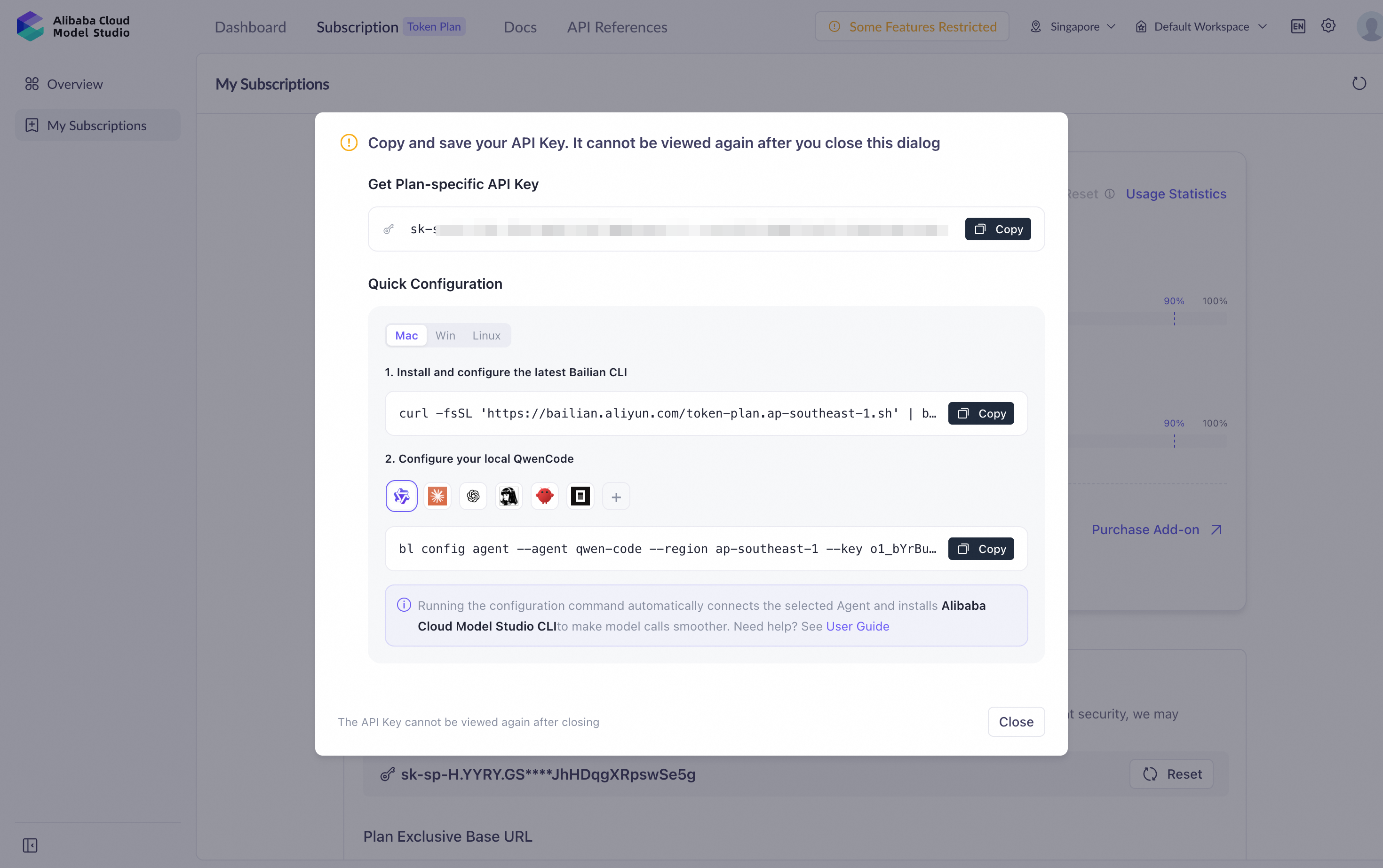
After subscribing, you receive a dedicated Token Plan API key in the sk-sp-xxxxx format. Linking it to the CLI takes one command:
bl auth login --config token-plan --api-key sk-sp-xxxxxThat's the entire setup. The CLI recognizes the sk-sp- prefix and routes every request to the correct Token Plan endpoints automatically — no base URLs to look up, no environment variables to export, no per-tool configuration.
Verify the connection:
bl auth statusYou'll see your active configuration, key status, and plan association. From this point on, every command in this guide draws from your Token Plan credit pool.
Optional (but strongly recommended): teach your AI agent the CLI
The CLI repository ships an official agent skill (skills/bailian-cli/). Install it once, globally:
npx skills add modelstudioai/cli --all -gWith the skill in place, AI agents like Claude Code, Qwen Code, and Codex can translate natural-language requests into the corresponding bl commands — one login, one skill install, and your AI agent speaks Model Studio. Agent-driven calls use the same sk-sp- key, the same credit pool, and the same pricing as commands you type yourself, and you can always drop down to the raw command. Throughout this guide, each scenario shows both tracks: what you'd ask your agent, and the command that runs underneath.
Step 2: Morning Check-In — Check Your Credit Balance
First coffee, first check — ask your agent, or run the command yourself:
In your agent: "How much Token Plan credit do I have left this cycle?"
bl usage summary --days 7This prints your credit consumption for the current week alongside what's remaining in your active windows. It's the terminal equivalent of glancing at your fuel gauge before a road trip.
The numbers make more sense once you know how the plan refills. Like Codex and other leading AI subscription products, the Token Plan uses a rolling reset model with two cycles running in parallel:
- Every 5 hours, your short-window allocation refreshes — so even after a heavy sprint, you're never locked out for long.
- Every 7 days, your weekly ceiling resets — guaranteeing consistent throughput across the whole billing period.
There's no flat monthly pool to ration or hoard — the 5-hour + weekly dual reset is built for sustained daily use. The bl usage summary output reflects both windows, so a quick morning check tells you exactly how much headroom today's work has.
Step 3: Spot the Crunch — Check and Raise Quotas in Real Time
Mid-morning, our developer kicks off a batch data-analysis job — hundreds of CSV-processing calls to Qwen3.8-Max-Preview. Before launching, a quick capacity check:
In your agent: "Am I close to my rate limit on qwen3.8-max-preview?"
bl quota check --model qwen3.8-max-previewIntroduced in v1.8.0, this renders a live progress bar of your current RPM and TPM consumption against your limits. If the bar is already running hot, you'll know before the batch job starts throwing rate-limit errors — not after.
And when you can see a crunch coming, you don't have to file a ticket or hunt through console pages. Request a temporary limit increase right from the same terminal:
In your agent: "Request a temporary TPM bump on qwen3.8-max-preview."
bl quota request --model qwen3.8-max-preview --tpm 8000000The request is submitted, tracked, and applied without leaving your shell. Later, if you want a record of what was raised and when:
bl quota historyEvery quota adjustment, timestamped and auditable. To review the standing limits on any model, bl quota list --model qwen3.8-max-preview has you covered.
Step 4: Optimize Spend — Make Every Credit Count
Lunch break is a good moment for housekeeping. Three habits keep a Standard-tier subscription feeling much bigger than it is.
Burn expiring free credits first
Model Studio grants free-tier quota on many models, and free credits have expiry dates. Find what's about to vanish:
In your agent: "Do I have any free-tier credits expiring soon?"
bl usage free --expiring 3This lists free-tier grants expiring within 3 days. Route today's non-urgent workloads there first — expired free credits are the only truly wasted ones.
Schedule heavy work for off-peak hours
Off-peak discounts (22:00–08:00 Beijing Time) stack with your Token Plan credits — during that window, supported models consume fewer credits per call, so the same allocation stretches further. The exact multiplier varies by model; check the current per-model off-peak rates before scheduling.
The practical move: queue batch jobs, long agent runs, and bulk generation for the off-peak window. For developers in US and EU time zones, that window overlaps most of the working day — this isn't a night-owl trick, it's your default operating mode.
Verify the savings actually happened
Optimization without measurement is guesswork. Check your per-model trend:
bl usage stats --model qwen3.8-max-preview --days 30Thirty days of consumption data for your flagship model, straight to the terminal. If your off-peak scheduling is working, you'll see it here.
Set a global guardrail
Finally, if you want strict control over whether free-tier quota gets consumed at all, there's a global switch:
bl usage freetier --all --on    # allow free-tier consumption
bl usage freetier --all --off   # disable it entirely
Prefer finer control? Swap --all for --model <model> to toggle free-tier consumption per model. Useful when you're benchmarking real credit costs, or when you'd rather save free grants for a specific project.
Step 5: Produce Across Modalities — One Credit Pool, Every Format
Afternoon: a product launch needs copy, a hero image, a short video, and a voiceover. On most stacks that's four subscriptions and four API keys. Here it's four commands against one credit pool.
Write the copy with Qwen3.8-Max-Preview:
In your agent: "Draft the product launch copy with qwen3.8-max-preview."
bl text chat --model qwen3.8-max-previewAn interactive session with the flagship model — draft the product description, punch up the headline, generate the landing-page FAQ.
Generate the hero image from the finished copy:
bl image generate --prompt "Minimalist product hero shot of a sleek developer terminal on a desk, soft studio lighting, launch-day banner style"Turn the image into a video. Since v1.10.1, the CLI accepts local files directly — image editing, image-to-video, reference-to-video, and vision understanding all take a path on your disk, no pre-uploading to a URL required:
bl video refPoint it at the hero image you just generated, and the video model uses it as the visual reference for the launch clip.
Add the voiceover:
In your agent: "Add a voiceover to the launch clip."
bl speech synthesizeCopy, image, video, narration — one afternoon, one terminal, and every call billed against the same Token Plan credit pool. No modality silos, no separate invoices, no key juggling.
The v1.10.1 local-file upgrade matters more than it sounds. Multimodal pipelines used to mean uploading intermediate assets somewhere public just to reference them. Now your working directory is the pipeline.
Step 6: Scale Into Your IDE — Same Model, Same Pool
Evening wind-down: back to feature work in the IDE, with an AI coding agent handling the heavy lifting. There are two levels of integration here, and they build on each other.
Level one: your agent drives the CLI. If you installed the official skill during setup, agents like Claude Code, Qwen Code, and Codex can already run your entire Token Plan day in natural language — credit checks, quota requests, multimodal generation, all of it. You ask in plain English; the agent invokes the matching bl command, billed against the same sk-sp- key.
Level two: your plan becomes the agent's model backend. One fully-specified command connects your coding agent to the plan:
bl config agent --agent claude-code --base-url https://dashscope.aliyuncs.com/apps/anthropic --api-key sk-sp-xxxxx --model qwen3.8-max-previewSpell out all four pieces — the agent, the base URL, your sk-sp- key, and the model — and the CLI configures the agent to run through your Token Plan. That means the model answering inside your IDE is the same Qwen3.8-Max-Preview, burning the same credit pool you've been managing all day. Agents supported today include claude-code, qwen-code, opencode, openclaw, hermes, and codex.
For developers juggling multiple projects or environments, the CLI also supports named configuration profiles — keep your Token Plan setup, a work account, and an experimental sandbox isolated from each other, and switch between them cleanly instead of overwriting a single global config.
This is the full-circle moment: terminal chat, multimodal generation, and IDE-embedded coding agents all draw from one subscription, tracked by the same bl usage commands you ran at breakfast.
The Model Studio CLI Cheat Sheet
Everything from the day above, plus the rest of the toolkit. Use it two ways: as a typing reference, and as a map of what actually runs when an agent drives the CLI for you — these are the exact commands it executes under the hood.
Managing your plan
Command | What it does |
| Link your Token Plan key; endpoints auto-routed |
| Verify active configuration and key status |
| Credit consumption and remaining balance |
| Per-model consumption trend |
| Free-tier grants nearing expiry |
| Free-tier consumption switch (use |
| Standing rate limits for a model |
| Live RPM/TPM progress bars |
| Request a temporary limit increase |
| Audit trail of quota adjustments, optionally filtered by model |
| Wire a coding agent into your plan |
Spending your credits
Command | What it does |
| Interactive chat with the flagship model |
| Omni-modal interactive session |
| Image generation and editing (local files supported) |
| Video generation, editing, and reference-to-video |
| Vision understanding on images (local files supported) |
| Text-to-speech and speech recognition |
| Built-in web search |
| Upload files to the platform |
| Invoke a platform application |
| MCP server integration |
| Chain multi-step multimodal workflows |
Key Takeaways
- One command links your plan:
bl auth login --config token-plan --api-key sk-sp-xxxxx— thesk-sp-prefix auto-routes every request to the Token Plan endpoints. - Credits refresh on a 5-hour + weekly dual reset — there is no flat monthly pool to ration.
bl quota checkrenders live RPM/TPM progress bars;bl quota requestraises limits without filing a ticket.- Off-peak hours (22:00–08:00 Beijing Time) stack with Token Plan credits, so supported models consume fewer credits per call.
- Text, image, video, and audio all bill against one credit pool, and since v1.10.1 the CLI accepts local files directly.
- One
bl config agentcommand runs your IDE coding agent on the same Qwen3.8-Max-Preview and the same credit pool. - The official agent skill (
npx skills add modelstudioai/cli --all -g) lets Claude Code, Qwen Code, and Codex drive every command in natural language — same credit pool, same pricing, and you can always drop down to the raw command.
Frequently Asked Questions
What is the Model Studio Token Plan for Individual?
The Model Studio Token Plan for Individual is a personal AI subscription that provides a shared credit pool covering every text, image, video, and audio model on Alibaba Cloud Model Studio. Credits reset every 5 hours and every 7 days, and early-bird pricing starts at $6/mo.
How do I connect the Model Studio CLI to my Token Plan?
Run bl auth login --config token-plan --api-key sk-sp-xxxxx using the dedicated sk-sp- key you receive after subscribing. The CLI detects the prefix and routes all requests to the correct Token Plan endpoints automatically — no base URLs or environment variables required.
How often do Token Plan credits reset?
Credits follow a 5-hour + weekly dual reset: your short-window allocation refreshes every 5 hours, and your weekly ceiling resets every 7 days. Run bl usage summary --days 7 to see both windows at any time.
Which model powers text and coding on the Token Plan?
Qwen3.8-Max-Preview, the flagship model debuting exclusively on the Token Plan, built for full-stack development, data analysis, and Office workflow automation. Call it with bl text chat --model qwen3.8-max-preview, or wire it into your IDE with bl config agent --agent claude-code --base-url https://dashscope.aliyuncs.com/apps/anthropic --api-key sk-sp-xxxxx --model qwen3.8-max-preview.
Do CLI commands and IDE coding agents share the same credits?
Yes. Terminal chat, multimodal generation, and coding agents configured via bl config agent all draw from the same Token Plan credit pool, tracked with the same bl usage commands.
Do I need to memorize all the bl commands?
No. Install the official agent skill with npx skills add modelstudioai/cli --all -g, and AI agents like Claude Code, Qwen Code, and Codex will translate natural-language requests into the corresponding bl commands. That dramatically lowers the learning curve, and every agent-driven call bills against the same Token Plan credit pool. The raw commands are still there whenever you want to run them by hand — the cheat sheet above covers the full set.
Start Your Own Day One with the Token Plan
The Model Studio Token Plan for Individual gives you predictable credits across every AI modality; the CLI turns those credits into a workflow you never have to leave the terminal to manage. Fuel and engine — that's the whole formula behind the platform's promise as the Foundation for AI Innovation.
- Subscribe — choose your tier on the Token Plan page (early-bird pricing from $6/mo, details in the pricing guide)
- Update the CLI —
npm update -g @modelstudio/clito v1.10+ - Connect —
bl auth login --config token-plan --api-key sk-sp-xxxxx - Build — everything else is one command away
One API key, one CLI, every AI modality — managed from your terminal. Subscribe now →